Manufacturing
- Details
- By David Cao
- Hits: 3384

Lifan 720 unmasked spyshot, it seems like Lifan do their best to assemble one Lifan 720 model before Shanghai Auto Show 2011, somehow they will improve their details in the coming production version.
Read more: Lifan 720 to Debut on 2011 Shanghai Auto Show Photos
- Details
- By David Cao
- Hits: 2314

FAW Besturn B90
FAW's Besturn B70, based on Mazda 6 platform, sales well in China's B class auto market for its high cost performance. FAW B70 is one of the few Chinese auto make recognized by Chinese customers.
From former spyshots, FAW B90 - a new model based on a brand new platform - will be bring into production this year. This model have not confirmed officially, but Besturn B90 is possibly the secret weapon of FAW for 2011 Shanghai Auto Show.
- Details
- By David Cao
- Hits: 2405

Chery E5 is set to display on 2011 Shanghai Auto Show.
Chery E5 integrates more western design elements, and put costomer's driving experience at the first place. This digitalized business purpose model takes TECH as its core selling point. In order to provide comfortable driving experience, Chery E5 equipped with CAN-BUS, ABS+EBD, NVH, and more then 20 store spaces.
Read more: Chery Next Generation Easter & E5 At Shanghai Auto Show 2011
- Details
- By David Cao
- Hits: 1284
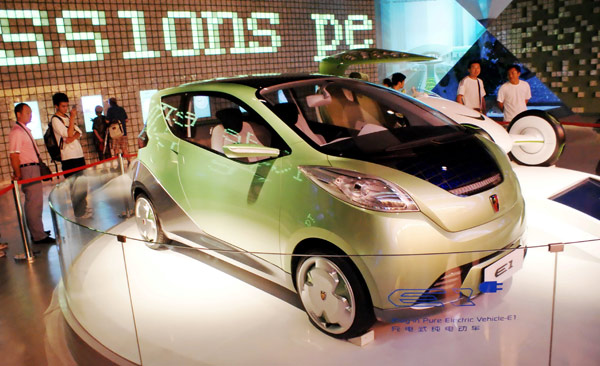
China will launch a development plan in energy-saving and the new-energy vehicle industry to make the country a leader in the sector over the next 10 years, with government funding of 100 billion yuan ($15.28 billion).
The long-expected plan, jointly drafted by the Ministry of Industry and Information Technology (MIIT), the Ministry of Science and Technology, the Ministry of Finance, and the National Development and Reform Commission, has been submitted to the State Council for final approval, said Su Bo, vice-minister of the MIIT.
According to the draft plan, which has a specific focus on hybrid and pure-electric vehicles, China is aiming for the top position in the global new-energy vehicle sector with sales volumes of 5 million units by 2020, as the government plans to invest in core technologies to build a strong and competitive new-energy vehicle industry chain.
The draft plan also said that during the country's 12th Five-Year Plan (2011-2015), China aims to have a production capability of 1 million new-energy vehicles, with pure-electric and plug-in hybrid vehicles accounting for 50 percent.
- Details
- By David Cao
- Hits: 1249

China's second lunar satellite, the Chang'e-2, has been safely operating for 180 days as of April 1, and has reached its six-month designed life, according to the State Administration of Science, Technology and Industry for National Defense (SASTIND).
More Articles …
Page 35 of 60