Manufacturing
- Details
- By David Cao
- Hits: 1626

Geely Plans 12 new models - while buying Volvo and rolling out electric vehicles
Zhejiang Geely Holding Group Co Ltd, which is close to finalizing a deal to buy Swedish luxury car brand Volvo from Ford Motor Co, plans to roll out a dozen new own-brand models this year.
Zhao Fuquan, vice-president of research and development at the privately owned carmaker, said the company will offer 12 all-new and upgraded products in 2010, including its first sports-utility vehicle (SUV) and first large-sized sedan.
The new models will have an engine capacity ranging from 1.0 to 2.8 liters, Zhao said.
Geely, with its headquarters in Hangzhou, capital city of coastal Zhejiang province, will also put its purely electric-powered and plug-in hybrid cars into small-volume commercial production this year, he added.
Liu Jinliang, the group's vice-president for sales and marketing, said Geely aims to sell 400,000 cars this year, up from 330,000 units in 2009. Its sales surged by 48 percent last year from 2008.
- Details
- By David Cao
- Hits: 1430
China is well on its way to becoming the high-speed railway capital of the world, with 33,000 km of these railways currently under construction and about 70 projects slated to launch this year.
By the end of 2012, China's high-speed railway is expected to account for half of the world's total length.
Currently, 2.1 trillion yuan ($300 billion) worth of rail construction projects are under way.
In the next three years, 26,000 km of new lines, including 9,200 km of high-speed lines, will be put into operation to ease the pressure on the country's overburdened rail network, said Liu Zhijun, Minister of Railways.
China's dominance in the high-speed railway market is remarkable, said Yang Hao, professor in railway transport with Beijing Jiaotong University.
"No matter the length of high-speed railways, or the operation speed of our high-speed trains, China now dwarfs other countries," Yang said.
Though many of the advanced technologies used in high-speed railways were imported from France, Japan and Germany, "China has learned them fast, and China also has its advantage in industrial integration", he said.
By 2013, 800 bullet trains will be churned out to zip through the cities at a speed of at least 250 km/h, the minister said. Also, a new-generation high-speed train, which insiders said is built to run up to 380 km/h on the future Beijing-Shanghai high-speed link, is also expected to roll off the production line and complete comprehensive tests this year, he said.
The country should also clinch more deals in the global railway market this year, the minister said yesterday.
This is the first time the goal is put into the minister's annual work report, which reviews achievements in the past year and sets new goals for next year.
Read more: Chinese High-speed rail network to take global lead
- Details
- By David Cao
- Hits: 1556
The Big Trend
In a symbolic shift of power, China overtook the U.S. in 2009 to become the world's largest auto market. For the first time, the number of locally made vehicles China produced outnumbered America's--and sales did too. As its consumers buy cars, aided by incentives from Beijing, China's flush manufacturers are vying to snatch up bits and pieces of ailing foreign automakers. Though just one deal was inked in 2009, 2010 will be the year that once-provincial companies exercise their newly acquired clout and make their mark in overseas markets.
The Unconventional Wisdom
It's not just the trillions of yuan in stimulus money the government is doling out that is driving the enormous uptick in China's car sales. Some of those incentives are geared toward rural residents whose purchases of refrigerators and air conditioners are also being incentivized. And a Cash for Clunkers-type tax rebate stokes interest in small, fuel-efficient models. But how to explain sales of luxury brands, like BMW, Audi and Mercedes-Benz, which are also on the rise in China? Farmers can't afford those, and buyers aren't getting kickbacks. The demand is real and unlikely to wane in the near future.
The Misplaced Assumption
As much as Chinese buyers crave the status an internationally recognized luxury brand confers, domestic automakers will also do well in 2010. That's because fakes don't stop at Coach wallets and Longchamp bags. It's not uncommon for Chinese to buy a Chinese model--because it's cheap but sports a shape similar to a foreign car--and then affix a new ornament to the hood or logo to the bumper for the neighbors' benefit. Cash-rich urbanites will want a real Rolls Royce; aspiring billionaires will make do with a locally made lookalike.
The Watch List
BYD. American billionaire Warren Buffet sent this automaker's stock soaring in the spring after buying a 9.9% stake, propelling its founder Wang Chuanfu to the top of Forbes China's list of the mainland's richest people. Cars are just the latest initiative for Wang, who started off making rechargeable batteries and handset components. While BYD's e6 electric car hasn't yet been approved for sale in China, let alone abroad, Buffett's vote of confidence can't be underestimated.
Geely Automobile. As the 10th-largest carmaker in China by both sales and production, Geely seems like small potatoes compared with rivals BYD, Chery and the joint ventures. But the Hangzhou-based company has made headlines this year, becoming the preferred bidder for Ford's Volvo unit. Expect it to lead other Chinese firms in the aggressive pursuit of foreign acquisitions, which will come cheap as U.S. and European auto markets continue to lag.
Up-and-coming markets. China's eastern coast, dotted with metropolises like Beijing, Shanghai and Guangzhou, boasts the greatest concentration of wealth. But first-time car buyers are also emerging from the country's vast interior. Take BMW: Of over 100 dealerships in China, it has some in the coal-and-steel center of Taiyuan and the far-flung northwestern outpost of Urumqi. Keep an eye out for an inland boom.
The Bold Prediction
China's passenger car sales will hit 12 million in 2010. (Sales were below 5 million in 2006 and totaled almost 10 million in 2009.) In this nation of 1.3 billion, where there are months-long waiting lists for cars and people can afford to make down payments with cash, cars are just one more conspicuous, concrete symbol of China's rise.
- Details
- By David Cao
- Hits: 1412
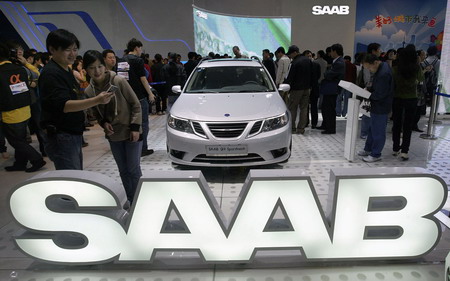
Beijing Automotive Industry Holdings Co Ltd (BAIC), China's fifth largest automaker, said yesterday it has agreed to take over some of the assets of General Motor's Saab arm as part of its plans to develop cars under its umbrella.
Saab Automobile AB said it has struck a deal with the Chinese carmaker to buy production equipment and intellectual property (IP) related to two older Saab models - the 9-5 and 9-3 including the powertrain technology and tooling.
Saab will also help BAIC to integrate the technology into future BAIC vehicles, said the statement.
However, Saab and BAIC did not disclose other details about the deal, including the financials. Reuters reported last week, citing unnamed sources, that BAIC had obtained a 20 billion yuan ($2.93 billion) line of credit from the Bank of China.
"This arrangement is excellent for both parties, now and for the future. We have developed a good relationship with BAIC and look forward to working with them to integrate the Saab technology into their future vehicles," said Jan Ake Jonsson, managing director of Saab Automobile.
Dagens Nyheter, a daily newspaper in Sweden, reported yesterday that "China is helping the Swedish car brand out of crisis".
Jia Xinguang, chief analyst with the Chinese National Automotive Industry Consulting and Development Corp, said the deal is not that significant for BAIC as the production platforms of Saab 9-5 and 9-3 have been shut down due to the old and outdated technologies and also have low efficiency and utility.
However, Jia is optimistic about BAIC acquiring Saab's powertrain systems, including turbo-charged engine and gearbox technologies, "which can fill the gap between China and global players in the transmission segment".
He also hoped that "maybe the locally produced sports cars with Saab 9-3 and 9-5's extraordinary performance will be popular among Chinese consumers".
"It's hard to judge if it is a worthy deal for BAIC at this stage," said Zhong Shi, an independent auto analyst based in Beijing. "The key is that if BAIC can finally get hold of something and use it later for itself."
BAIC is one of the few Chinese automakers not to have its own car brand and model, and also has limited production and research and development experience in passenger cars.
Zhong believes that BAIC will move the production line of the Saab 9-3 and 9-5 models to China and produce the same cars under a new brand name.
- Details
- By David Cao
- Hits: 1325
Chery Automobile, China's largest indigenous car maker, will basically stay away from overseas acquisitions even though it has been approached repeatedly, its chairman said on Tuesday.
"We have been offered many fancy proposals (by investment bankers). Their business is to buy and sell," Yin Tongyao said in an interview published on Sohu.com, a Chinese Internet portal.
"They want you to get married today and split the next day, this is typically what investment bankers do...and we won't be hoodwinked."
Yin also denied overseas media reports about Chery's purchase of a Fiat car plant on the Italian island of Sicily.
"I was told that foreign media said we had bought a Fiat plant. There is no such thing," Yin was quoted as saying.
Italy's La Repubblica newspaper had reported that Chery was in talks to take over the Fiat car factory.
Industry sources said that they were "bemused" and did not see it making sense for Chery, as the plant is on an island and the logistics of exporting had hampered its current owner, Fiat.
Chery executives could not be reached immediately for comment. Fiat declined to comment.
Still, many other Chinese automakers have been chasing Western brands to take advantage of a global industry downturn.
Beijing Automotive Industry Holding Co, the country's fifth largest automaker, has acquired some assets of General Motors' Saab unit as part of a push to develop its own-brand cars. Geely Automobile Holdings group has also been named preferred bidder for Ford Motor's Volvo car business.
Chery, maker of one of China's best-selling compact cars QQ, had also tried to raise its profile by cooperating with foreign automakers, but refrained from doing so to avoid risks, Yin said.
Rather than acquiring and trying to revive an overseas brand, Chinese automakers can also work their own way up to the higher end, he said in March.
Also in that month, Chery unveiled its first self-developed medium-to-high end sedan, Riich G6, which Yin and other Chery executives hope can eventually compete with Volkswagen AG's famed Audi A6.
In July 2007, Chery and Chrysler LLC agreed to manufacture compact cars under the Chrysler badge for sale in the Americas, but the plan was aborted after Nissan Motor reached a similar pact with the US automaker.
It has delayed a car venture with Fiat, which later forged a manufacturing partnership with Guangzhou Automobile.
More Articles …
Page 43 of 60