BizChina
- Details
- By David Cao
- Hits: 1384
Xinjiang's capital of Urumqi will be built into a "core city" in west China and an "international trade center" of central and west Asia by 2020, local authorities have announced.
The goal was set in an urban development blueprint for Urumqi during the 2011-2020 period, unveiled Tuesday after three years of study.
To achieve this goal, local authorities will build faster and more convenient transportation networks to strengthen links between Urumqi and inland Chinese regions as well as areas in central and west Asia, according to the blueprint.
Local authorities will build a new railway line linking Urumqi with Lanzhou, enlarge the current Urumqi railway station, and build a new airport terminal during the next 10 years, the blueprint said.
Read more: China aims to build Xinjiang's capital into int'l trade center
- Details
- By David Cao
- Hits: 1446
Chinese search giant Baidu said it has successfully removed 2.8 million files from its document-sharing website, Baidu Wenku, after getting slammed by Chinese authors who accused the company of encouraging copyright infringement and demanded compensation.
The controversy prompted at least dozens of writers to publish criticisms of Baidu CEO Robin Li, a billionaire and one of China’s most prominent entrepreneurs, over the past week. The criticisms included a satirical mock-interview titled “F— You Too, Robin Li” (in Chinese, English translation from ESWN here) that portrays Mr. Li as a corrupt executive who describes rights as “something to be violated,” and a blog post by famous Chinese novelist and blogger Han Han (in Chinese, English translation from Han Han Digest here) suggesting Mr. Li had built his considerable wealth on the back of others’ work.
The company responded by apologizing to writers and promising to remove infringing content by Tuesday, and saying it would shut down Wenku, known as Baidu Libary in English, if problems persisted.
Company spokesman Kaiser Kuo said that Baidu removed most of the files suspected of being unlicensed — largely found in its “literary works” category — as of 3 p.m. Tuesday, and is in the process of arranging a new discussion with representatives from the publishing industry. He said he couldn’t guarantee that 100% of the pirated content on Baidu Library is gone, but “I very much hope that they [the authors] see this was a good faith effort on our part and that it will form the foundation for future talks.”
Read more: In Bow to Authors, Baidu Scrubs Document Sharing Site
- Details
- By David Cao
- Hits: 1631
The Chinese computer maker Lenovo Group said on Monday that it plans to launch two or three new tablet computers later this year, accelerating its pace to catch up with Apple Inc's latest iPad 2.
Chen Xudong, vice-president of the world's fourth-largest PC vendor by market share, told China Daily that Lenovo plans to launch a new tablet computer for corporate users over the next two quarters. It will also launch the second version of its tablet computer, LePad, in the fourth quarter of this year.
"Like personal computers, different users will have different demands for tablet computers," said Chen Xudong, who is also the general manager of Lenovo's China business.
He said the country's biggest computer maker will adopt a "multi-model" strategy in its battle with Apple in the tablet computer market.
Lenovo on Monday launched its first tablet computer LePad, which is based on the Android 2.2 operating system. The product, starting at 3,499 yuan ($533), comes in two versions that support Wifi and 3G services.
- Details
- By David Cao
- Hits: 1886
With its steaming economy and surging ranks of billionaires, China has become the fastest-growing market for Airbus' private jet business, with at least 25 corporate jets to be sold in the next five years.
"The demand for corporate jets is already very high, and the government is more supportive of corporate aviation," Francois Chazelle, vice-president of worldwide sales at Europe's Airbus Corporate Jets, said at a news conference on Monday.
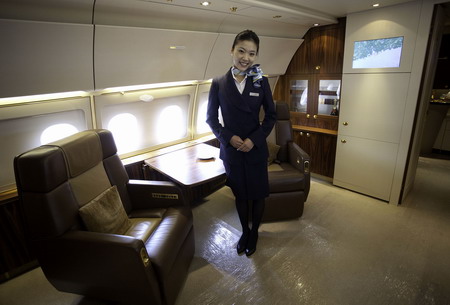
A flight attendant in an Airbus A318 Elite business jet on display at the Business Aviation Center during the Asian Aerospace International Expo and Congress in Hong Kong on March 9.
Eric Chen, senior vice-president of Airbus China, added: "Five aircraft a year is a conservative figure. We have already sold two in the first quarter of this year in China."
- Details
- By David Cao
- Hits: 1743
Shenyang Yuanda Aluminium Industry Engineering Co. is planning to seek listing approval from the Hong Kong stock exchange's listing committee April 7 for its planned US$400 million-US$500 million Hong Kong initial public offering, a person familiar with the situation said Monday.
The listing plan of the Chinese company comes as Tokyo-listed SBI Holdings Inc. is seeking to raise up to US$328 million in an IPO before listing in Hong Kong on April 14, according to a term sheet seen by The Wall Street Journal on Monday, in the first listing by a Japanese company in Hong Kong.
Yuanda Aluminium, established in 1993, makes curtain walls, a type of outer covering for buildings,as well as metal roofs, shading systems and glass skylights.
The company, which has a total annual production capability of 12 million square meters, built the membrane structure for China's National Stadium, also known as the Bird's Nest, and the National Olympic Swimming Center in Beijing, and has international branches in more than a dozen countries.
More Articles …
Page 41 of 126