BizChina
- Details
- Hits: 1352
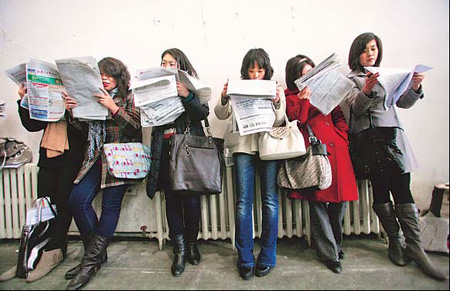
Job applicants flip through newspapers searching for employment information at a job fair held at the National Agriculture Exhibition Hall in Beijing late last month.
As nation battles to reduce unemployment, analysts say it is shortage of skilled workers, not jobs, that is causing problems. Daniel Chinoy and Wang Xiaotian report from Beijing.
Song Yongliang did everything right. He worked hard, went to college and majored in Russian, which he thought would be practical in his hometown in Northeast China.
In his senior year, he found an internship as a translator and hoped to find a job with a trading company near the Russian border after he graduated in 2008. Then the financial crisis hit.
- Details
- Hits: 1244


Analysts say trip reflects importance of China market
BEIJING: Toyota Motor President Akio Toyoda on Monday apologized to Chinese consumers - who make up the world's biggest auto market - over the company's massive global recall.
"The incident had caused worries to Chinese consumers," Toyoda told a packed news conference. "I hereby express my sincere apologies for these worries."
Analysts said the apology to Chinese consumers is significant as it acknowledges the importance of the Chinese market that has become increasingly key to automakers as they struggle with weak global sales. Last year, China overtook the United States as the biggest auto market.
"The China market is very important to Toyota, so I decided to fly here directly from the US in person to deliver my expression of apology and explanation to Chinese consumers in the hope of regaining trust here," said Toyoda, president and CEO of the world's second-largest automaker, and the grandson of the company's founder.
Read more: Toyota chief says 'sorry' in damage-control visit
- Details
- Hits: 1061
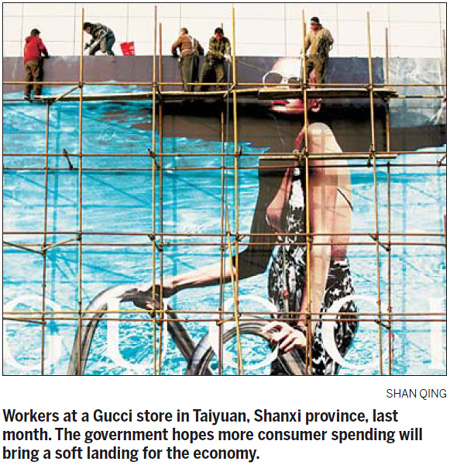
Central government also faces a dilemma in deciding on its interest rate policies.
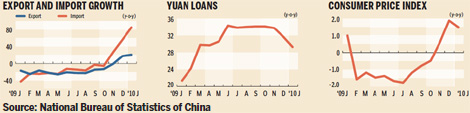
As inflation rises - it was 1.9 percent in December and 1.5 percent in January - the market has expected an interest rate hike to come sooner or later.
While the real interest rate risks falling into negative territory due to rising inflation, any hasty adjustment of it could hurt enterprises, especially job-creating private companies, and could even shake the newly recovered economy. It could also stoke inflows of speculative capital from overseas.
"While we expect the central bank to deliver 81 base points of rate hikes this year to avoid real rates turning negative, we do not expect aggressive credit tightening to last long," said Nomura Securities economist Sun Mingchun in a recent report.
Most economists forecast that inflation could reach 3 percent in February, when consumption was active thanks to the traditional Spring Festival, which started Feb 14. And they said there was a possibility of inflation rising further in the coming months, partly due to the relatively low base a year ago.
- Details
- Hits: 1157
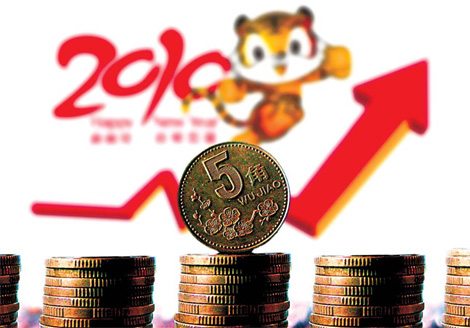
China's stimulus measures were more akin to a blunderbuss than a sniper's bullet. As economist Stephen Green said, "Everything that could be done was done."
But now, there are increasing signs that the country wants to target its policies more precisely.
Following two hikes in the reserve requirement ratio of commercial banks - the proportion of money they must keep aside as reserves - it is widely believed that a new bout of policy tightening has begun.
The hikes came after the authorities imposed a series of real estate-targeted policies late last year, sending an unequivocal signal that the rapid rise in home prices is intolerable, analysts said. Interest rate hikes could also be in the pipeline if inflation continues to pick up.
- Details
- Hits: 1075
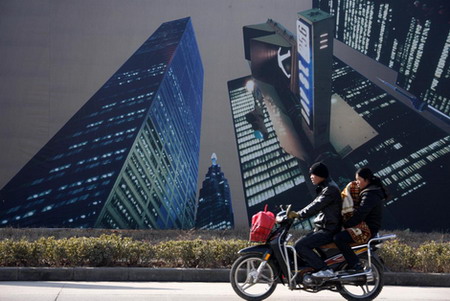
Home sales in major cities contracted while property prices remained stable during the Spring Festival holiday as buyers and property developers wait for more policy clues from the upcoming sessions of the nation's legislature and advisory body.
According to China Index Institute, a real estate industry research organization, cold winter weather halted many transactions in Beijing, Nanjing and Hangzhou during the Spring Festival holiday - between Feb 13 and Feb 19.
"Intense tightening of real estate policies has intensified buyers' wait-and-see attitude, while shrinking supply also led to sluggish sales," said Hu Jinghui, vice-president of 5i5j, a real estate agency based in Beijing.
While new apartment prices remain at near record-high levels, property prices in Shenzhen and Hangzhou have dropped, though it still remains above 20,000 yuan per sq m. New apartment prices in Chongqing, Wuhan and Tianjin also hit record highs.
Some property developers are still planning price increases in March.
Statistics from Soufun.com, a real estate industry website, show that 52 property projects will be launched in Beijing next month, with an average price of 22,000 yuan per sq m, up from 19,383 yuan per sq m during the holiday.
Despite low property sales, customer sentiment has undergone subtle changes compared with last year.
While some buyers are still taking a wait-and-see attitude, others would rather take advantage of the market's downturn.
During the seven-day holiday, property agency Centaline China's 130 outlets in Beijing received 1,000 buyer representation requests, up 67 percent from the same period last year. According to a survey by the agency, 52 percent of customers are still searching for the right home and will buy if they find one that matches.
Since the Spring Festival is usually a slow period for home purchases, industry experts say market trends will be clearer after March, especially after the "two sessions", the annual meetings of the National People's Congress and the Chinese People's Political Consultative Conference.
Since late January this year, nine ministers have launched fact-finding missions to investigate markets in both first- and second-tier cities, covering hot issues including curbing speculative home purchases, building more affordable housing and improving land-leasing practices.
The initial results of the missions will be submitted to the State Council before the two sessions take place, and will serve as the basis for policy consideration.
An industry expert who took part in one mission said property prices would probably pick up in the second quarter, so policies may tighten accordingly prior to that period.
Qin Hong, deputy director of the policy research center under the Ministry of Housing and Urban-Rural Development, said the central government will probably enact more real estate policies during or after the two sessions, to promote the healthy development of China's property sector.
More Articles …
Page 71 of 126